Siloed customer data, no single view
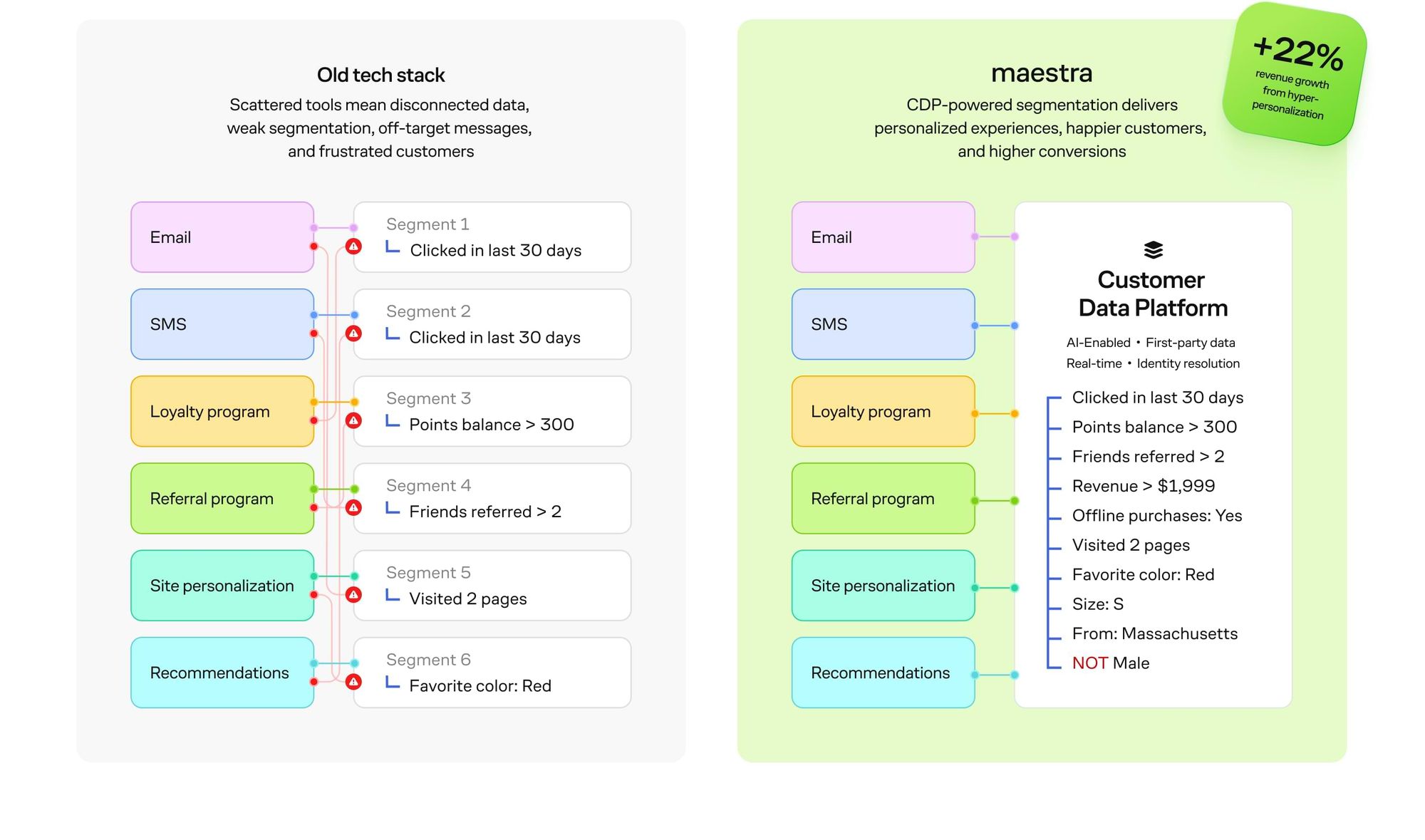
Same person, four records, four versions of the truth
Maestra Platform resolves them into one profile that every channel reads, an all-in-one retention marketing platform for ecommerce brands with a forward-deployed marketer on the account.
Brands running on Maestra






The problem
You can't segment what you can't see
Without a unified profile, segmentation becomes a manual exercise: exporting lists, cross-referencing spreadsheets, and hoping nothing changed since the last pull. Real-time targeting is out of reach when the underlying data is scattered.
What we hear from brands
a multi-brand fashion group: siloed systems mean no real-time customer segments, so we rely on manual list pulls
an online jewelry retailer: manual segmentation between email and SMS, with no unified customer-journey view
a wine-accessories retailer: the lack of a CDP limits a unified view of customers and segmentation
The new way
Your data unified without a migration project
A dedicated forward-deployed marketer moves your data, rebuilds your flows, and sets up your integrations, while your current tools stay running until the switch is complete. Billing only starts once migration is done, so you are not paying before the system works.
Outcomes brands report
Customer proof
One person can run the whole program once the data is in one place

The headcount a marketing operation needs is mostly the headcount its tooling demands. With the data unified, running the programs stopped being a specialist job.
25%
lead-to-customer conversion rate
“With Maestra, a single person can run an entire company's marketing activities, and that person doesn't even need to be particularly tech-savvy.”
How it works
Who does what during the switch
You approve the plan
Access to the current stack and a yes to the migration plan is the whole ask on your side.
Your marketer rebuilds
Data, flows, and campaigns are rebuilt on Maestra while the tools you are leaving keep sending, including the domain warm-up that protects deliverability.
You switch when it is ready
Two to four weeks for growing brands, three to seven for the most complex setups, and 99% of the work sits with your marketer either way.
The platform
Real time means the visit you are in right now
Profiles update as the shopper moves, at 2M requests per minute with responses under 300 milliseconds, so a recommendation or a banner reacts to what happened seconds ago instead of what a nightly sync knew this morning.
Including
Your forward-deployed marketer
The account load is the whole trick
Attentive service depends less on goodwill than on arithmetic. A Maestra marketer carries fewer than 15 accounts where 60 or more is normal elsewhere, which is what makes a 5-minute response and four strategy meetings a month something you can plan around.
Fewer than 15 accounts per marketer, versus 60+ industry-wide
5-minute response time versus 72 hours elsewhere
4 strategy meetings a month instead of 1
Replace your stack
The connectors go too
Every tool in a stack needs a connection to the store and to the other tools, and each of those is a thing that breaks quietly. Consolidating removes the maintenance along with the vendors.
Worth a look if any of this sounded familiar
The product pages show what the platform does with the data once it is in one place.